
Paradox and Hypocrisy Went on a Picnic One Day


Image generated with ChatGPT - Dall-E
There are similarities between the hypocritical and the paradoxical that can lead one to confuse the latter with the former. But this error is much worse if it happens the other way around and it is believed that someone hypocritical is only doing so to show how paradoxical life, the mind, or language can be. Therefore, it is important to clarify, as far as possible, the differences between these two possibilities and the territories for action that derive from them.
The Paradoxical
A paradoxical attitude or statement implies a contradiction or a situation that challenges intuition or common sense. It does not necessarily indicate something about a person's character, but rather about the nature of the statement or situation. For example, saying "I am a compulsive liar" is paradoxical because if it is true, it turns out to be false at the same time, and vice versa. Paradoxes often arise unintentionally or as a result of a complex situation. They can be used deliberately in literature, philosophy, or rhetoric to provoke reflection or illustrate a point. Therefore, being paradoxical is not inherently unethical. It often stimulates debate or deeper thinking about different topics and that has the potential to benefit Humanity.
The Hypocritical
Hypocrisy involves behaving in a way that contradicts what one claims to believe or feel. It shows the Machiavellian character of a person, indicating a discrepancy between their supposed values and the execution of actions that contradict them. For example, a person who advocates for environmental conservation but frequently engages in wasteful energy practices is being hypocritical. Hypocrisy often involves a conscious choice, where an individual deliberately acts in a way that is inconsistent with their beliefs or values. Consequently, hypocrisy is generally considered unethical, as it involves deceit or lack of integrity.
A Picnic for Many More than Two
By crossing the paradoxical and the hypocritical, different categorizations of people or groups of people can be presented:

Hypocrite with Paradoxical Thought: Wishy-Washy. This is someone who behaves hypocritically and at the same time expresses paradoxical ideas, showing confusion between their actions and thoughts. It conveys a sense of inconsistency and lack of trust. These are people or organizations that might be indecisive or unstable in their convictions and thoughts but perhaps have the clear mission of creating confusion.
Hypocrite with Non-Paradoxical Thought: Cynical. This is someone who acts in a way that contradicts their beliefs or straightforward, non-paradoxical statements. They emphasize, even proudly, the deceptive or insincere aspect of their character, ignoring accusations of applying double standards, scorning honesty, and mocking the goodness that can inspire human actions. This is typical of people or organizations that commit abuses of power, violating Human Rights they claim to respect.
Non-Hypocrite with Non-Paradoxical Thought: Transparent. This is someone aligned with their clear and straightforward beliefs. The person shows authenticity and consistency both in thought and behavior, so much so that in some cases, they can be counterproductively naive and predictable. These are people or organizations that are easy to understand and trust because their actions directly reflect their declared beliefs.
Non-Hypocrite with Paradoxical Thought: Philosophical. This is someone who genuinely lives according to their beliefs but enjoys engaging with complex, contradictory, or paradoxical ideas. The person has depth of thought and appreciation for intellectual challenges. These are generally riskier people or organizations than the others and often contribute to advances in Humanity, although obviously, they are not exempt from making mistakes.
The Surprise Element
I recently read a review of a research done in the USA on how hypocrites are perceived (https://insight.kellogg.northwestern.edu/article/surprising-role-of-surprise-in-hypocrisy). It reports that if the hypocrite is previously considered wishy-washy, people are not so surprised when they come out with a new hypocrisy, so the severity of what they say is perceived as less serious than if it were someone considered serious and responsible when caught saying something hypocritical.
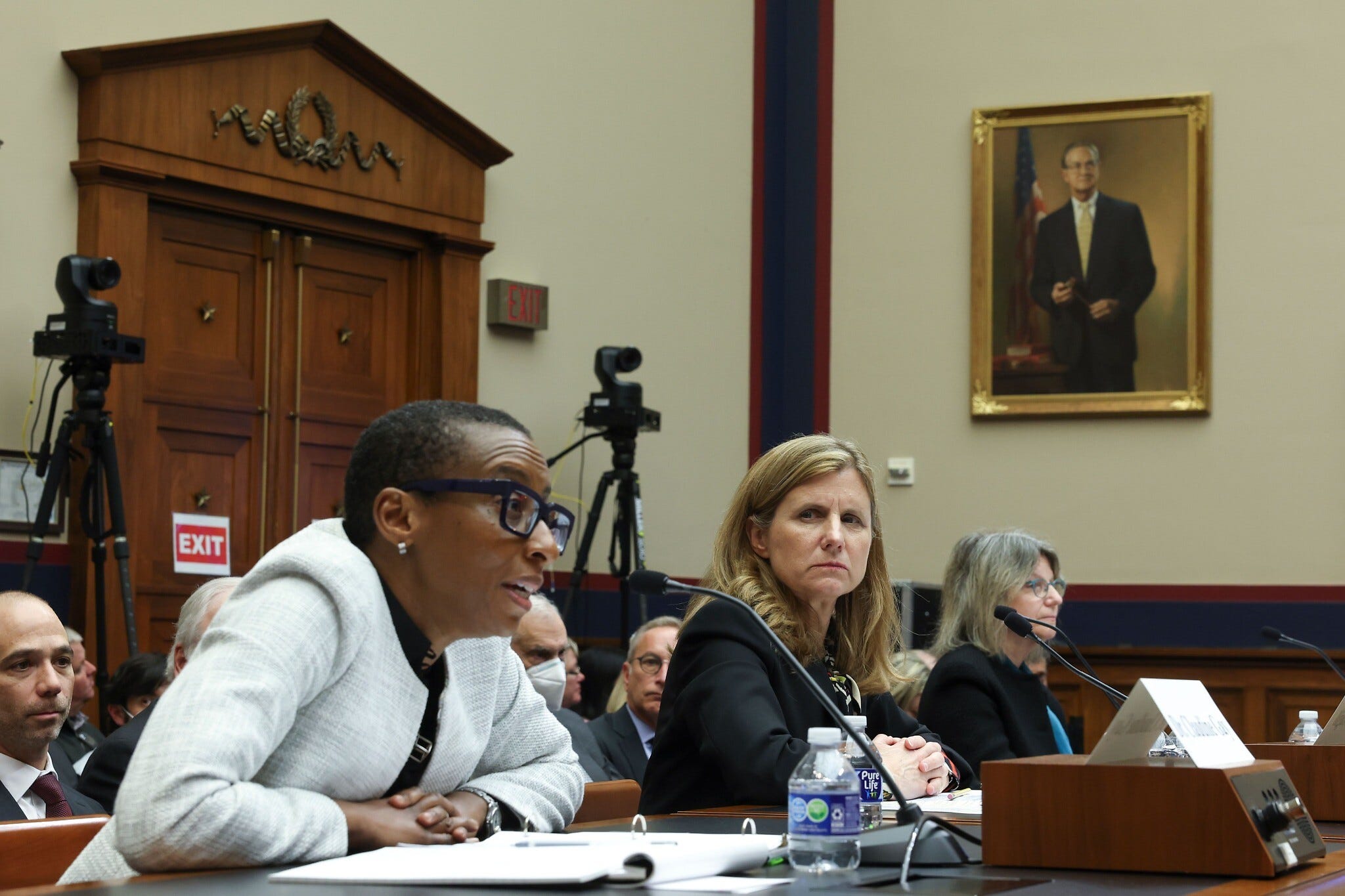
Image taken from the PITTSBURGH JEWISH CHRONICLE (Kevin Dietsch/Getty Images)
Perhaps this is why the questioning of the presidents of Harvard, Penn, and MIT universities caused such a stir in public opinion. The responses that the three presidents gave to the questions of a congresswoman were so wishy-washy and even so definitively hypocritical that many of us could not believe that this was happening. Unfortunately, that surprise surprised us.
It is natural that in academic environments, the risk of moving in paradoxical, apparently contradictory territories is assumed, but from a philosophical perspective and within the framework of complete respect for freedom of thought, research, and opinion. However, for about a decade, the paradoxical and the hypocritical have been confused in many universities, causing freedom of expression to be excessively limited to prevent certain groups of people from feeling affected when mentioned. This limitation has in many cases led to the cancellation of events and the expulsion of people from their professorship or other positions because they said something at some point that was considered offensive to certain groups such as women, blacks, LGBTQIA+, Muslims, etc. This is what has been known as "cancel culture."
Given these precedents, it was expected that expressions shouted and written on campuses, offensive to the Jews as a people, would receive similar treatment to what has already been typical of these practices inspired by radical social justice and cancel culture. But it has not been so, and for this reason, these three presidents were summoned to account before the Congress of the USA. The president of the University of Pennsylvania resigned after that uproar, while the one at Harvard has been ratified in her position by the governing body that supervises her.
Swampy Ground
It is not easy to move with paradoxes to which the mind, language, and attempts to move the needle in communicational territories such as Science, Politics, and Art naturally point, without falling into apparent hypocrisies and ending up looking like just another cynic. Communicating complex ideas is an art, and if it is done live in front of the media, it becomes even more difficult because there is normally no time to do it without falling into confusion and errors. Therefore, wishy-washy, cynics, and transparent people generally dominate the public scene: the former generally because they fill the enormous available space with confusing content; the second because through their speech acts they exercise the power they already have, abusively; and the third because while they are understood, in many cases what they do is reinforce pre-existing situations without aiming for any type of change, some for the good of Humanity, but others due to their naivety do not guarantee any benefit and even help cynics benefit from it in some way.
'Don't be hypocritical' is a transparent advice that would be very cynical of me to suggest after this analysis that seems somewhat wishy-washy. I also don't want to fall into the naivety of recommending that, if you haven't already done it, you adopt a philosophical approach to your life. Just observe what you do and what others do; for now, that will be enough on this picnic day.
Huy no! Too many things mixed in a confusing way in this post....
It is transparent to me that you have a bone to pick with whatever you call cancel culture. I perceive, that you are doing a good old thing that the right wing people warns frequently about: you are shooting straw men.
It seems to me that you are more or less inventing a set of categories, crossing two things, and then using what you just created to criticise cancel culture. But I think this is a strange sideway manner to get to your goal. If you want to criticise cancel culture, do so. No need to invent strange categories.
About your categories, I think that you mix two things that do not belong in the same domain. Hypocritical refers to a person. Paradoxical refers to an argument. Already there you are mixing apples and pears. And then it gets more weird when you describe the crosses. A cynic doe snot have to be hypocritical. A cynic can be very transparent. Cynic is scarcely related with being hypocritical. Check the dictionary definitions...
So I would say that I am very interested in whatever arguments you have about what you call cancel culture. I think that cancel culture as such does not exist, and it is just another straw man. But that does not matter here. What I see is that you created straw categories, and you are applying them to events that you dislike. Hum...
Thank you Inti for reacting to this post!
Maybe your right with the use of hypocrisy as a category to be related with cynicism, so that it led to a certain confusion. But I used it to refer to purport a blatant lack of ethical behavior. I would argue that cynics are essentially unethical because they usually say that they believe in a lie, regardless that they do know it's a lie and regardless that they ultimately recognize that it's a lie, or don't. So, I've chosen "hypocrisy" to avoid the riddles of messing up with ethical considerations while keeping the point closer to what I wanted to say...
Well, regarding to the crossing of categories I like to do that. I know that I take risks by doing so, and I may get into problems. But, from my point of view, in this case I think I mixed red and green apples, but not apples and pears. One category refers to a general behavior of people (to be hypocrite or not); and the other refers to a certain classification of what the people can be saying (to say something paradoxical or not) in a given situation. The strawman critique could also be an observation on the validity of the experimental character of what I'm doing in this case when crossing categories to try to analyze a complex situation.
What I witnessed when the US Congress committee asked the three ivy league university presidents, was puzzling. I couldn't understand why they were behaving as they did. So, I came up with this risky way of explaining such phenomenon by relating it to the pervasive penetration of radical social justice perspectives into the very top echelons of top universities in the USA. Only that penetration could have explained why these presidents didn't utter a simple answer to the very clear question posed to them. They were exposed to be accused of applying a double standard of ethical norms, in front of a large audience outside the confortable settings of academia where it's supposed to be a safe place to debate everything. But ironically, the penetration of RSJ and its concomitant cancel culture practices have been erasing the safety of the debates in universities, in which a nuanced answer like the ones they intended to offer during their interrogatory, could surely be given without concern.
An approach to truth is an essential component of both the academia and the legal system. The immanent presence of paradoxes in our mind processes makes it hard. But, it's even harder when a dogmatic, identitarian way of dealing with narratives of particular "truths" gets in the way, cancelling anything that don't match such stories just because they're different.
I'm not sure if I managed to explain myself regarding your commentaries, but I'm aware that this topic of my criticizing of progressive politics is one that we've been dealing with for quite a while. and we're probably not going to agree this time either.